Yiwei Sang
Home/Work/About
Let’s Create Something Together
sangqiqi1001@gmail.com
“Time flies when you’re having fun” — anyone who has surfaced from a VR headset knows the feeling: the clock has moved further than you have. I wanted to know whether that distortion could be designed on purpose, without asking for a single free hand.
Role:
Researcher, interaction designer & hardware prototyper — solo
Type:
Independent research, developed into a wearable hardware prototype
Duration:
4 months, 2023
Tools
Arduino & AccelStepper · Rhino & 3D printing · VR headset & environment
VR already warps time. Nobody designs that on purpose.
Time-perception research keeps pointing at the same handful of levers — age, emotional state, and above all, attention. The more absorbed we are in something, the less attention is left over for tracking the clock, and the shorter the experience feels afterwards. VR is an unusually strong version of this: immersive environments reliably make people underestimate how much real time has passed once the headset is on.
Almost every VR design decision leans on this same absorption effect — better graphics, better sound, deeper presence. One channel is mostly left alone: touch. Most headsets already occupy both hands with controllers, which makes touch awkward to design for — and also the one sense with room left over to design with.
If attention drives the distortion, and touch can hold attention without competing for the hands, could passive haptic feedback become a deliberate dial for how long an experience feels?
How do I approach experimental research?
Four experiments — two of which told me I was asking the wrong question.
Same 7 participants returned across all four rounds over 4 months — close enough contact to track how each finding reshaped the next round’s design.
01
What can truly influence time?
We began with the most obvious starting point: the hands. Participants carried out a number of simple tasks using both their dominant and non-dominant hands, whilst we tested the effects of different temperatures and task difficulty on their time predictions. I recorded the actual time taken and compared it with their subjective estimates.


Finding
Handedness barely mattered. What mattered was focus — the moment attention locked onto the task, felt time reliably compressed, on either hand
02
Can a visual layer push the effect further?
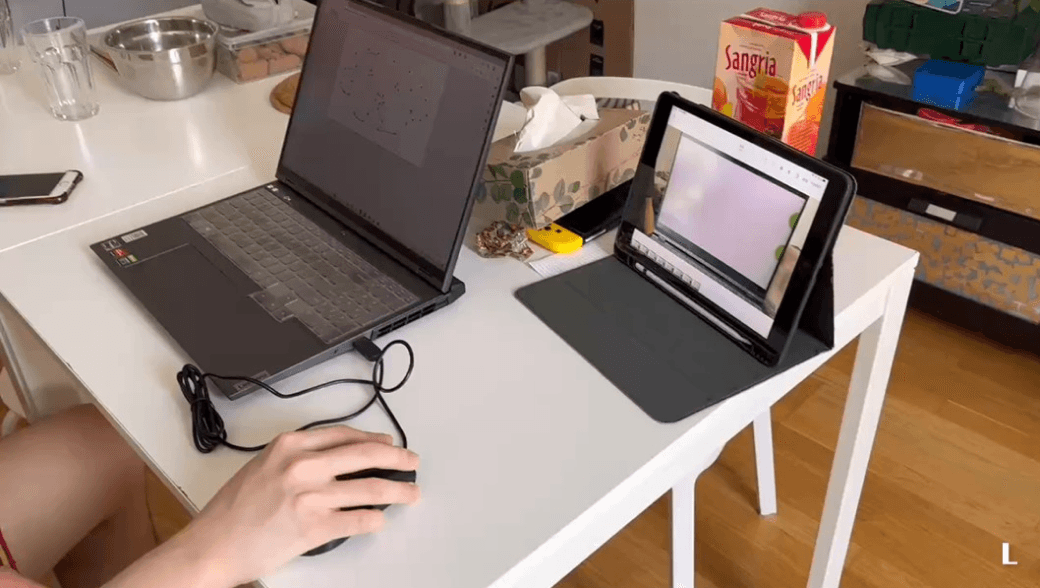
Experiment 1 demonstrated that using the non-dominant hand, high temperatures and more difficult and demanding tasks can prolong the duration; therefore, vision may be another contributing factor. I ran a looping video — a simple ball, its colour, motion and rhythm varied across trials — on top of the same hand task from Exp.01.



Finding
The hand task swallowed the effect. Whatever the visual variation was doing, it disappeared next to the pull of an active task — no measurable effect of its own.
?
The real question was passive: what happens to time perception once the hands are busy, and skin is the only channel left to design?
Both experiments assumed a hand would be free to perform a task. Real VR rarely works that way — the hands are almost always full of controllers, and the eyes are already doing the heavy lifting. I’d spent two rounds chasing a condition that barely exists in the environment I actually cared about.
03
Testing touch with the hands out of the picture
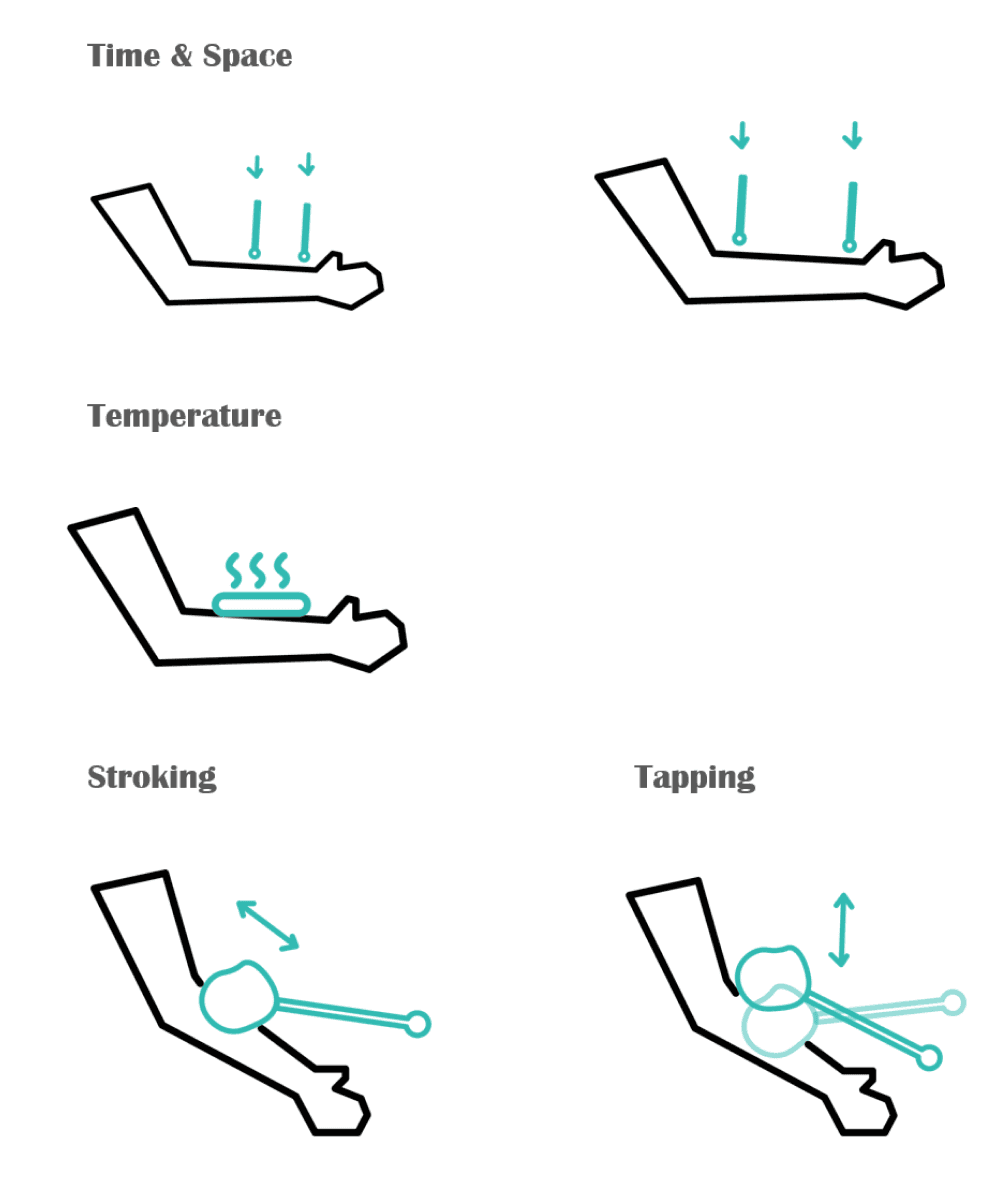
Participants wore a VR headset watching a set of short videos while I tested a range of tactile feedback patterns directly on their forearm — varying location, rhythm and motion — logging felt time against real time throughout.


Finding
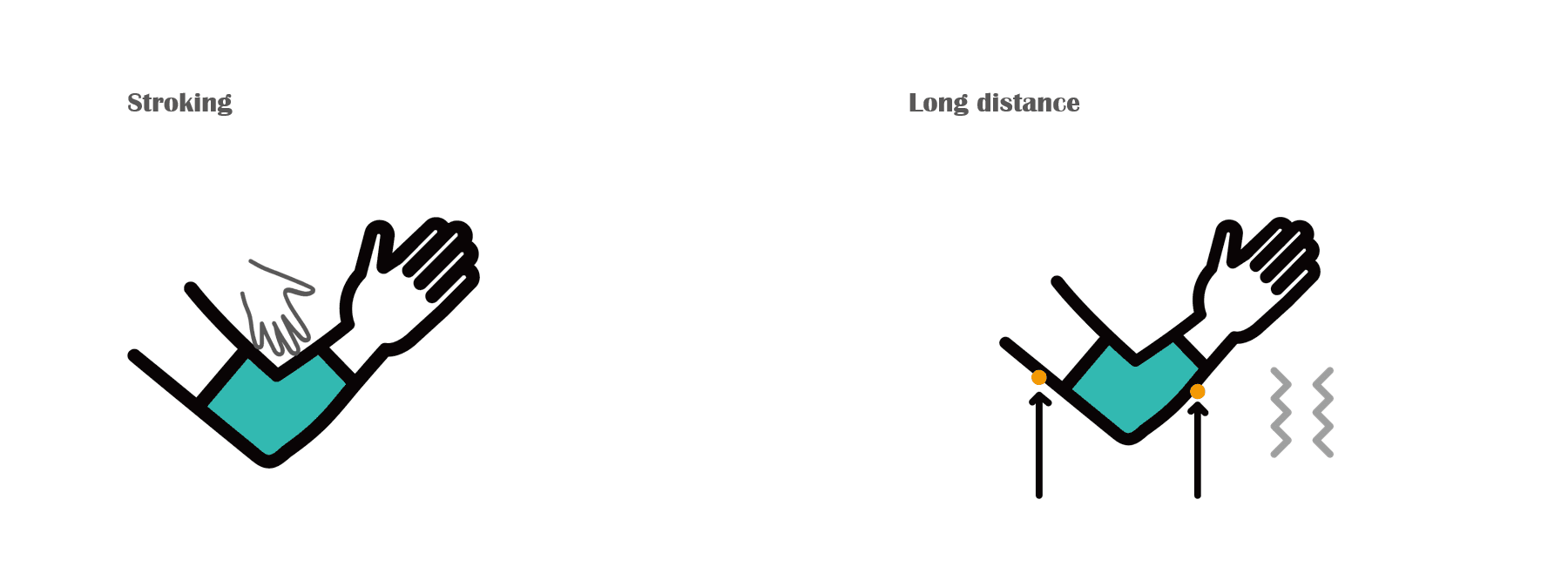
Two patterns broke through the noise: a simulated stroking motion, and tapping at spaced points along the arm. Both shifted felt duration significantly on the first pass.
04
Building the two winning modes into one device
With stroking and tapping confirmed as the two feedback modes worth keeping, I modelled and 3D-printed an enclosure, paired it with a simple VR environment, and ran a final round measuring felt time against real time across both modes.

Finding
Confirms passive touch — not vision, not an active task — as the strongest lever available once a headset is on and the hands are full.
How might we
Turn passive touch — delivered where the hands are already free to hold a controller — into a deliberate dial for how long a VR experience feels?
Three parts, one variable held constant.
The VR environment and its pacing stay identical across every condition — touch is the only thing that changes, so any shift in felt time can be traced back to the sleeve, not the scene.
VR environment
Sets the visual pace — a simple looping scene the participant watches throughout, kept constant across every feedback condition.
Haptic sleeve
Worn on the forearm, two switchable modes — Mode One taps at points along the arm, Mode Two drives a belt-mounted bead in a continuous stroke from wrist to elbow.
Controller
An Arduino reads a single serial command — for the stroke motor, for the tap motors — and drives either without interrupting mid-motion.
What have I built?

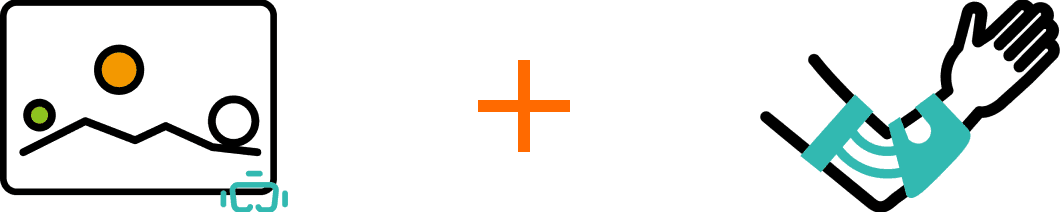
Early rig, worn live during a VR test session — vibration motors on a breadboard, wired straight to a laptop.

Mode One · TAP
Discrete vibration pulses at spaced points along the forearm — a series of taps rather than a continuous motion.

Mode Two · STROKE
A belt-driven bead glides continuously from wrist to elbow — the closest the mechanism gets to an actual stroking hand.

Concept render — exploring a sleeker enclosure for the same belt-and-motor mechanism.
The biggest result of this project wasn’t the two feedback modes that worked — it was the two experiments that didn’t.
Next: a small, unmoderated public test of the museum concept, and a result screen designed to turn one visitor’s guess into something worth comparing with a stranger’s.

ElasticTime
A wearable haptic system that studies — and bends — how long a moment inside VR feels.
Independent research · Haptic Hardware prototype · VR Enviroment