Yiwei Sang
Home/Work/About
Let’s Create Something Together
sangqiqi1001@gmail.com
Project type:
End-to-end app, Haptic Product design, Team work
Tools:
Figma - Illustrator - Procreate - Arduino - Rhinoceros - 3D print
Role:
Project Manager, User Researcher, Sole UX/UI Designer, Product Designer
Duration:
4 Months

A friend of mine shared a handmade project with me — a necklace she created by selecting beads that represented her different emotional states. She showed me the entire process, and through choosing each bead, she gained a deeper understanding of her emotions.

This experience inspired me.

How the problem arose?
Emotions play a critical role in everyday life, yet many people struggle to accurately perceive or record their emotional fluctuations. This lack of emotional awareness can lead to difficulty adapting to emotionally charged situations and may hinder the development of empathy.
Without effective tools for emotional reflection, individuals often remain unaware of the complexity and nuance of their emotional experiences.
Based on existing research on self-awareness and emotions
Globally, only 36% are considered emotionally intelligent, meaning nearly two-thirds have insufficient emotional awareness
36%
Only 10–15% of people are highly self-aware, while around 85–90% lack strong self-awareness
10-15%
85-90%
Around 62% of individuals are unaware of their own emotional triggers
Problem tree
people are not self-aware of their emotions
Regularly avoid introspection
No sense of what their bodies are feeling
Fear of the truth
Not able to see oneself clearly and objectively
Can't recognize their strengths and challenges
Habit of hiding their negative emotions
Rarely share personal thoughts to close friends/family/loved ones
relationships with people can be hurt in a long run
Makes them question their self-worth
Inability to make emotional judgements in the moment of the situation
Can't make behavioral adjustments when necessary
Can't connect emotions to their behaviour
Can't control emotions
Fear of being vulnerable
Turn a blind eye on self-evaluation
Fear of being wrong
Potential for growth and development of emotional intelligence is los
Consequences
Main Problem
Causes

What is the purpose of the project?

Enhance users' emotional awareness — helping them move from recognising single, basic emotions to understanding a broader spectrum of emotional states. Encourage regular emotional reflection and develop users' capacity for emotional insight and empathy.
Paper research
We reviewed knowledge about cognitive theories of emotional awareness and used the Levels of Emotional Awareness Scale as the basis for subsequent user interviews.
The Emotion Colour Ring and a self-assessment manikin capable of measuring emotions were chosen as the methods for subsequent presentation of emotions.


Research
Competitive Analysis
-All three competitors included social features, but combined with the interviews, users did not want this feature.
-All competitors did not provide users with enough motivation to record.
-States showing a single emotion were predominant.
-More than 80% of users are women of the younger generation

USER research
Semi-structured user interviews
Six people in the 20-50 age range were interviewed through a combination of offline and online methods
Expected results:
-Understand people's level of awareness of emotions
-Understand people's habit of recording emotions
-Discover the feedback people want on their emotional problems

-Younger people (between 20-30 years old) are more likely to feel they need to raise their emotional awareness
-The type of emotion determines the desire to share it
-Most people will do this by recalling the scene where the emotion is occurring at the moment
-Unconscious emotions are the most likely to be ignored
Problem:
There was a lack of age span during the interviews, with a lack of samples from the children's group and the older age group
A Day In The Life
After completing the interviews, we selected a specific user for behavioural observation.

-Unconscious emotions can interfere with normal social activities.
-Memories alone are not effective in raising awareness of emotions.

What inspiration did I get from the process above?

I can't always feel and pinpoint my emotions in time, and I always feel like something has changed if I look back again.
-Youth aged 24

Young people are more sensitive to emotional changes but often fail to react in time when emotions occur
Subsequent recollections carry information bias— not timely or accurate enough
Users preferred a process of dialogue with themselves, not a form to fill out

How might we
Help users capture unconscious emotions in the moment, while making the process of reflection feel like a dialogue — not a form to fill out?
Ideate
With the HMW problem, we brainstormed as many solution inspirations as possible, and ultimately wanted to go through the smartwatch side + app side + product-side system design to solve the multifaceted problem points.
Where and how will the user achieve the product goals?

Heartbeat
Vibration
Sunrise
Social events
Other events
Personal
At home
Sunset
Vibration
Biometric data
Data transfer
Vibration
Lights
Questionnaires
Reflect
Acquisition of data
Heartbeat
Detecting Unconscious Emotions
Making emotional notes
Reflect on interactions using the product
A three-part system
Rather than a single touchpoint, Re-feel is a system designed to capture, record, and reflect — each component solving a distinct problem.

01 — CAPTURE
Smartwatch
Detects unconscious emotion changes via biometric data. Sends a simple initial alert and syncs the information to the app.
Solves the "missed moment" problem.

02 — RECORD
Mobile App
Core recording and reflection space. AI-guided dialogue for accurate emotional logging. Visual timeline of emotional changes over time.
Solves the "inaccurate recall" problem.

03 — REFLECT
Haptic Device
Physical object for emotional reflection and healing. Communicates emotions through colour changes and vibration intensity. Plush surface and rounded shape.
Solves the "reflection without depth" problem.
When creating the first version of the sitemap, I referred to competitors’ user flows and category structures. I positioned the journal feature as the homepage focus and designed the emotion-recording process to allow users to make their own choices independently.
Sitemap V1

Problem
-Problems with the order of page settings
-Page functions are not clear enough and are too repetitive
-Wrong selection of key pages
Key design decision — introducing AI
Why can't we provide users with a more personalised and intimate interactive experience?
Due to the popularity of AI tools, I realised that using an AI to communicate with the user — then having the AI summarise the communication and give the user their emotion type — without restricting the user's expression would make the app more interactive. This was confirmed through usability testing with a card sorting system.
Considering that AI reduces the number of input steps, users need to be told when to use AI and given choices — ensuring each user has the same level of understanding and the right flow.

Chat Mode
Keep it mysterious — chat to me. AI infers your emotion from open conversation.

Language Mode
Choose the moment you want to record. Guided structured input.

Self-Record Mode
Say what you want — I'll always be there for you. Free-form, always available.
After completing the above user testing, I refreshed the sitemap to give the page order and logic a new look.
Sitemap V2

I started by drawing low-fidelity wireframes with paper and pen, which allowed me to quickly define the idea and identify each element and component. Then I digitised it and built the process.
Lo-fi Wireframe


Ideas for Beginning


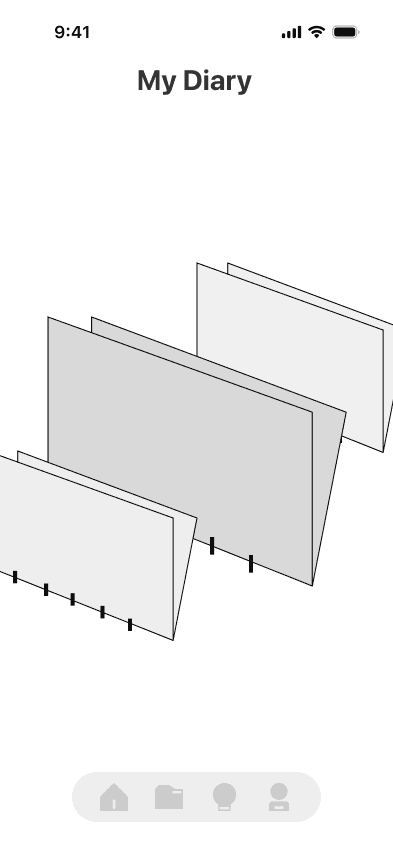


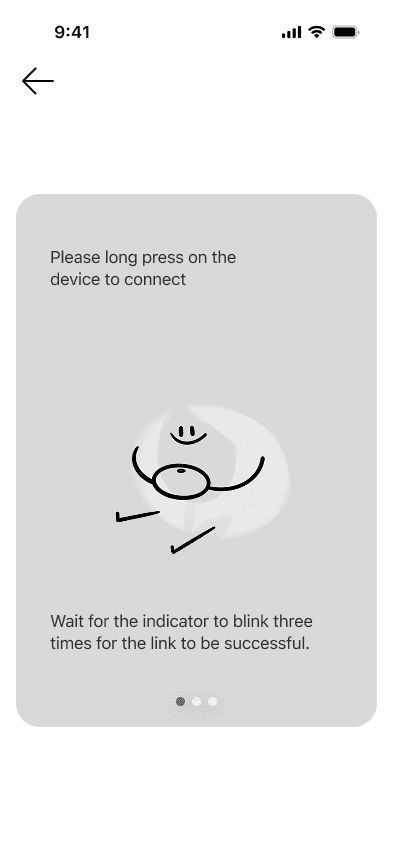
Input Process
View Record/Review Process

Let’s use the Design together!
Prototype
Solution——a comfortably smooth process.
Re-feel works by recording the user's emotional changes and acts as a subject to actively guide the user through the scenarios in which the emotions occur and are recorded and reviewed. This allows people to be better with their emotions.


UI Kit
I aim to attract a more diverse group of young users, rather than focusing solely on a female audience. Therefore, the overall design is intended to be approachable without appearing overly soft. The color system is based on emotional color associations identified in previous literature, with the addition of purple as an accent color. The UI toolkit provides visual guidelines, which will be applied consistently throughout the subsequent high-fidelity design stages.











SF Pro
SF Pro
SF Pro
SF Pro
SF Pro
Weekly
Weekly
Weekly
Text...
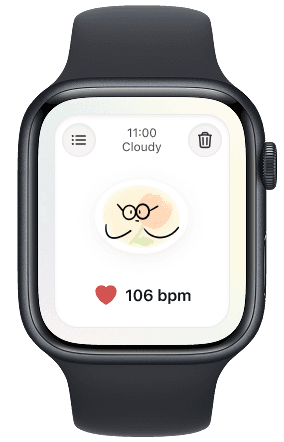
The smartwatch performs a simple initial alert after detecting a change in the user's mood and syncs the information to the app.
Accurate records, easy reminders
Choose the moment you want to record and come chat to our feeler!
JUST Talk to me!
Language Mode


Keep it mysterious, chat to me
Chat Mode


Say what you want, I'll always be there for you!
Self-Record Mode


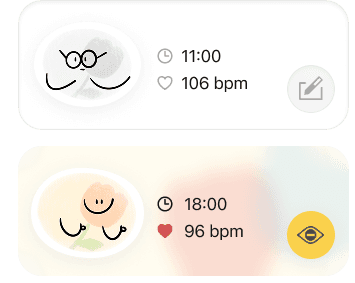
Based on our dialogue, I figure out the best mood flower for you.
I also summarise our conversations in a diary, so come and see if it matches your mood.
Get a unique emotional diary
The visual presentation gives you a better understanding of the emotional changes during this time.
Better understanding of mood changes


Find a corner of quiet solitude and feel the power of emotional meditation with our products!
Use of products for emotional reflection and healing
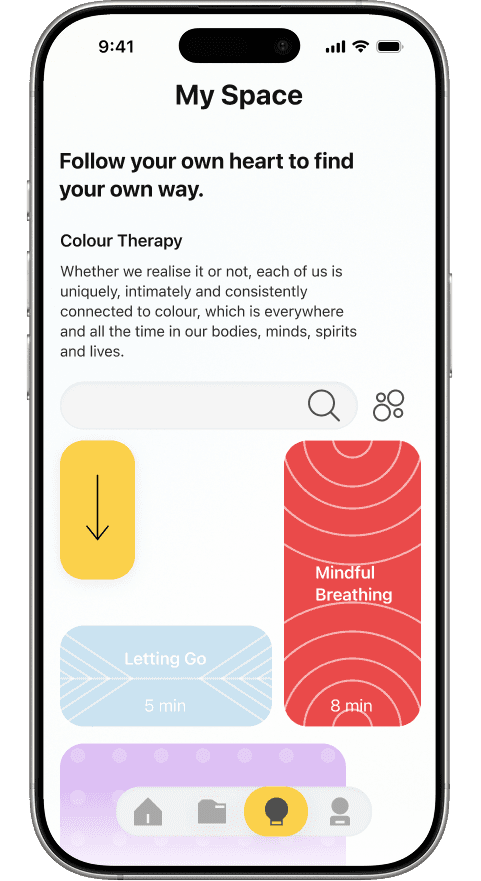
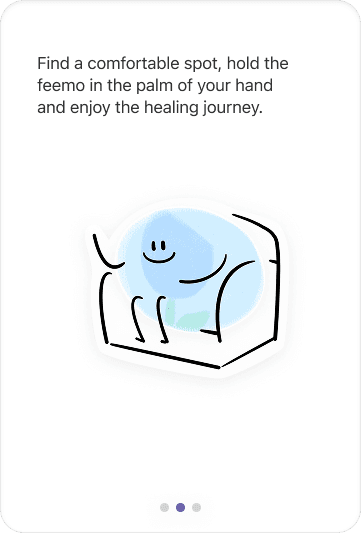

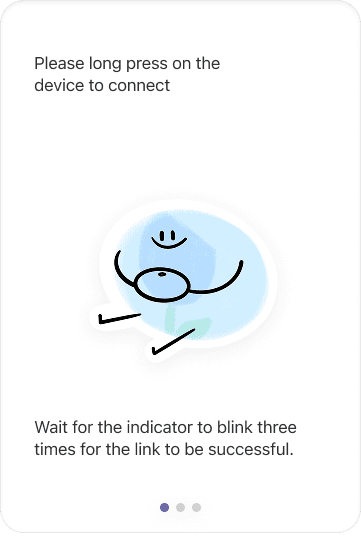
What experience does the product give you?
-You can feel different emotions through the change of product colours and different emotional intensity through vibration.
-The plush surface material and rounded shape will make you feel relaxed and immersed.


How users evaluate our designs?


Exhibition and testing at citylab Berlin
Test

What worked
Very useful for people with emotional difficulties
Keeping a diary felt therapeutic
The overall experience was good
Increased ability to define own emotions

What needs work
AI functionality unclear to some users
Acceptance of AI-generated emotional content
Extent of recording was uncertain
AI interaction process needs more clarity
Where do we go from here?
What I learned
Careful observation of user behaviour can help to narrow the scope of a project and develop reasonable hypotheses.
Effective user feasibility testing can be conducted at any critical point, and choosing the right approach can greatly improve the accuracy of the design.
The physical product resonated strongly, especially for users dealing with emotional difficulties

Issues for further improvement
-No post-exhibition iteration due to time constraints
-AI onboarding needs to build more user trust
-Acceptance of AI-generated emotional content
-AI interaction process needs greater clarity


Are we really aware of our emotions?
Emotional recording and reflective interaction —
connect to your inner self.