How the customer-operations product took shape.
This design deep dive moves from navigation and page hierarchy to the customer-workspace iterations, three page-level decisions, reusable components and responsive results.
Start with the places people need to move between.
I conducted client interviews, mapped the existing work and analysed customer data.The company had an existing SaaS tool and transaction data, but no repeatable proactive outreach process. Repeat purchases relied on customers returning and on the owner’s personal memory—even the owner could not clearly identify which relationships were strongest.
Product architecture

How products are designed?
Three pages support one contact workflow.
The workbench explains, the customer workspace supports action, and contact history makes outcomes retrievable.
Current page responsibilities
Workbench
Recommended customers
AI work rules
What is the AI using?
Before users open their profiles, they should first familiarise themselves with the product’s recommendation mechanism.
Customer workspace
Timeline + result
Evidence + contact
Customer list
Why this customer, and what next?
This is the page I revised: from displaying imported data to supporting a salesperson’s decision, contact and follow-up record.
Why this customer, and what next?
The information architecture was not finalised from the outset, but was refined following two rounds of testing.

Data was visible, but the job was not.
The prototype proved that API data and scores could render. It did not tell a new salesperson who to contact, why, or what to record afterwards.
Version 01 / Display data
Evidence and contact came together.
This page has been updated to include sections such as ‘Telephone Contacts’, ‘Evidence’, ‘Scripts’ and ‘Notes’; however, the categorisation of contacts is not sufficiently clear, and the contact records still do not form a closed loop.
Version 02 / Bring action into the page

Priority → evidence → action → record.
The current hierarchical structure has been organised according to the scoring results and highlights the most relevant evidence, enabling users to gain access to more useful information.
Version 03 / Follow the decision

Contact history
Contact records
Search + filters
What happened across customers?
Make cross-customer outcomes searchable, apart from one customer’s profile timeline.
Zoom in where the workflow changes.
These examples show how the three page responsibilities become specific interface decisions: make AI legible, preserve customer context and make outcomes easy to retrieve.
Three page-level decisions

AI Prediction Standards
Show the category structure, not protected scoring weights or formulas.

Follow-up history
Display contact history and orders so that sales representatives can review the background of a case before their next call, and so that this information can serve as a basis for follow-up scoring.

Contact history
Lists allow users to easily view all historical contact records and carry out comprehensive client organisation.

Show AI work rules before the first recommendation.
Keep contact and order events in one timeline.
Distinguish between the profile timeline and cross-client reviews.
How products are implemented?
Establish reusable and consistent design guidelines for future vibe coding
I used Coze and Claude to accelerate exploration, then corrected hierarchy and interaction details against reference screens. The component library made those decisions reusable across the product.
Design system
One customer-list item, reused across the workspace.
The item combines identity, recency and a prioritisation signal. Default, hover and selected states help a salesperson scan the list and keep track of the open profile.

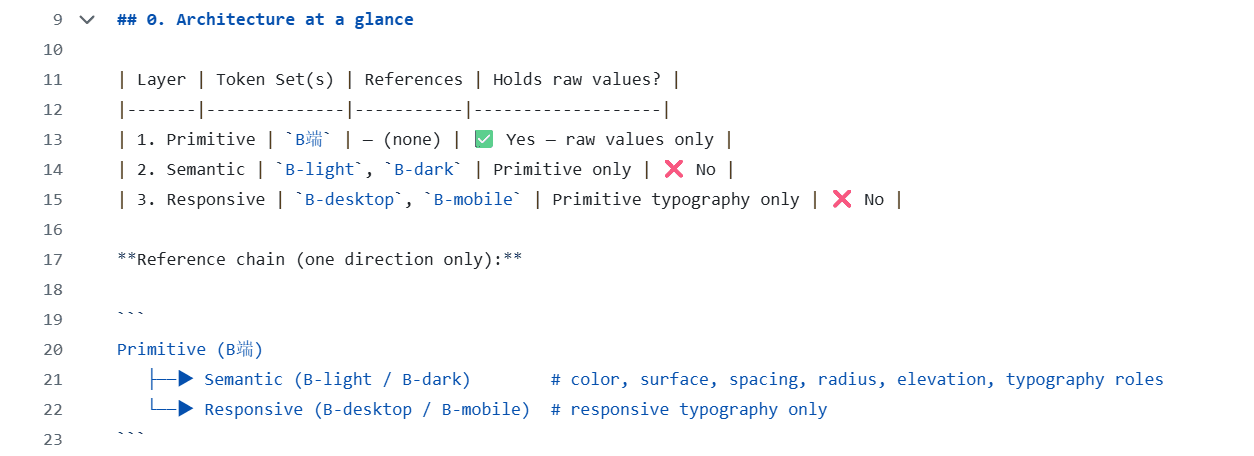
Semantic Design Tokens in JSON
In accordance with the brand guidelines and the WCAG 2.1 Level AA contrast standards, I used Claude to generate semantic JSON markup for colours, spacing and component states. I mapped this markup to the Figma drafts and Coze UI settings, and subsequently reviewed the results manually.


Claude Code + Figma Make — draft generation and human QA
AI-assisted design
I changed
A
客户 A
09:23
张晓明
暂缓
我们商量了为端午节备货的事,并当场确认了订单。
联系结果已保存。AI将在下一次评分中使用该结果。
查看
后续事宜:待进一步联系时再行讨论
AI handled
A
客户 A
09:23
张晓明
暂缓
我们商量了为端午节备货的事,并当场确认了订单。
联系结果已保存。AI将在下一次评分中使用该结果。
后续事宜:待进一步联系时再行讨论
AI handled
Drafted component variants; applied token values; prepared asset exports
I handled
I revised hierarchy, long text, responsive states and interaction rules
One workflow across screen sizes.
During our initial interviews, we discovered that the customers of small and medium-sized enterprises primarily use mobile phones; therefore, responsive design is crucial for our product.
Responsive design


For business rationale, service model and trial outcomes, return to the main case study


Yiwei Sang
Home/Work/About
Let’s Create Something Together
sangqiqi1001@gmail.com